

Evolving Acoustical Design Requirements for U.S. & Canadian Schools

Acoustics as a Foundation for Learning Equity
Across North America, acoustics is becoming an essential—rather than incidental—part of school design. Whether the setting is a general classroom, library, therapy space, or performance hall, the sonic environment directly influences comprehension, focus, and overall wellbeing. The effect is especially pronounced among students with hearing loss, auditory processing disorders, or learning differences, but benefits extend to every learner. With today’s schools expected to serve as inclusive, multi-use environments, achieving acoustical quality has evolved into a sophisticated acoustical engineering requirement.
Acoustical Related Details in U.S. Codes and Regional Practices for Classrooms
Although there may be many existing classrooms with poor acoustics in the United States, classroom acoustics for new projects can now be guided by a well-developed framework of standards, certifications, and code references. Chief among them is ANSI/ASA S12.60, which sets out performance targets for background noise and reverberation times in educational settings. Though technically voluntary, this standard has been widely adopted, directly or by reference, in various certification programs and local codes.
For permanent classrooms, S12.60 specifies maximum unoccupied background noise of 35 dBA, with reverberation limited to approximately 0.6–0.7 seconds depending on room volume. The aim is to ensure a favorable speech-to-noise ratio of at least +15 dB which is critical for clarity of instruction.
Several influential green building programs have made these targets foundational. The Collaborative for High Performance Schools (CHPS), which recently joined The Center for Green Schools at the U.S. Green Building Council (USGBC), requires core classrooms to meet these noise and reverberation benchmarks, going so far as to require acoustical modeling, minimum absorption values for finishes, and post-construction verification. LEED v4 BD+C Schools requires core learning spaces to meet reverberation, background sound from HVAC and exterior noise requirements as a minimum prerequisite. For projects seeking additional acoustic credits, these can be achieved with improved background sound (≤35 dBA for HVAC noise) and the use of partitions with sound insulation performance rated in accordance with the S12.60 classroom classification system.
Additionally, jurisdictions adopting the International Green Construction Code (IGCC) must adhere to S12.60 under indoor environmental quality provisions. Educational spaces applicable under this framework must be designed and tested to meet the acoustical metrics defined in the standard —effectively making compliance enforceable by law in those regions.
Many U.S. school districts now embed these standards in their capital project guidelines or facilities design manuals, often requiring early engagement with acoustical consultants to confirm that building systems, material choices, and zoning layouts can support the required acoustical outcomes.
Canadian Acoustical Codes and Regional Practices for Schools
The Canadian Acoustical Association identifies ANSI/ASA S12.60 as the recommended reference for both permanent and relocatable classrooms, and many architects and school boards design to these benchmarks even in the absence of a legal mandate. In this way, best practices in Canada increasingly reflect the guidance of U.S. standards.
In Ontario for example, educational facility guidelines published by the Ministry of Education and the Elementary Teachers’ Federation of Ontario reference speech intelligibility principles consistent with ANSI S12.60. Some school boards require reverberation times of 0.6 to 0.7 seconds for general classrooms, and <0.5 seconds for special education rooms and therapy spaces. Partition sound insulation performance and ambient noise limitations are often embedded in tender specifications, especially for projects pursuing LEED certification or following Infrastructure Ontario’s alternative financing and procurement models.
In Alberta, school design is required to follow the requirements in Alberta Infrastructure’s Technical Design Requirements document, which includes acoustic requirements for sound insulation (STC), impact noise (IIC), background noise from HVAC, reverberation control, exterior noise impact on classrooms, and environmental noise impacts from school equipment on surrounding uses. The criteria generally follow guidance from ANSI S12.60 and are reviewed/updated on a biennial basis.
Tailored Acoustic Strategies by School Room Type

Special Education Classrooms and Speech Therapy Rooms
These spaces require more stringent acoustic performance than general classrooms. Lower noise thresholds and faster reverberation decay are necessary to ensure clarity for students with sensory sensitivities or hearing impairment. Design considerations typically include more robust partitions, acoustic ceilings, and mechanical systems with extremely low noise ratings.

Libraries and Media Centers
Spaces dedicated to reading and digital research demand isolation from adjacent high-activity areas. highly sound insulating walls, acoustic ceilings, and properly isolated mechanical systems help ensure quiet. Visual openness must often be balanced with acoustic zoning to prevent acoustic intrusions from collaborative spaces.
Cafeterias and Dining Areas
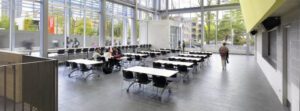
Acoustical design in cafeterias is often overlooked, leading to chaotic, loud and reverberant environments. In contemporary schools, sound-absorbing baffles, ceiling clouds, and washable acoustic wall panels are used to reduce reverberation while preserving hygienic conditions. Acoustic treatment for these spaces provides additional flexibility for their use as learning environments.
Performance and Rehearsal Rooms
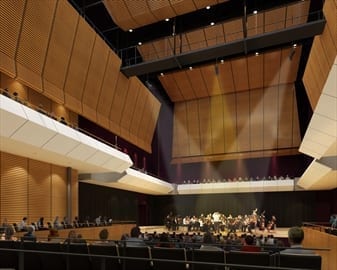
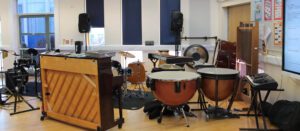
Music rooms, theaters, and auditoria must meet precise reverberation goals suited to their primary function—usually around 1.0 second for general-purpose performance halls. These spaces also need strong sound isolation to separate the activities from classrooms or adjacent areas, at times necessitating floating floors, resiliently mounted high-mass walls, etc.

Administrative and Counseling Offices
Confidentiality is paramount. Highly sound insulating partitions, solid-core doors with acoustical gaskets, and sound masking systems can help preserve privacy and reduce psychological stress.

Multi-Use Gymnasiums and Exam Halls
Today’s gymnasiums are often multi-purpose spaces. In addition to sports, they often serve as assembly venues, theater backdrops, and high-stakes exam halls. Acoustical strategies must manage both high volumes and flexible functionality. This often requires absorptive ceiling panels and wall treatments, and strategic zoning of HVAC diffusers to minimize noise intrusion during quiet events.

Workshop Classrooms and Technical Labs
Labs and shops introduce unique challenges with high levels of mechanical noise or robust vibration considerations, often with adjacencies to quiet classrooms or study zones. Acoustical solutions here focus on sound insulating (STC-rated) walls, slab breaks, vibration isolation mounts, and layout planning to minimize acoustic interference with academic classrooms.
The Case for Early Acoustical Planning
Each of these diverse school environments presents its own acoustical challenges. No single rule or material can ensure compliance with evolving design standards and user expectations. To achieve consistent performance across a school campus—one that supports accessibility, wellbeing, and instructional clarity—it’s essential that acoustical consultants be engaged during the earliest stages of planning.
Whether the goal is to achieve CHPS or LEED certification, meet regional procurement standards, or simply deliver the best possible learning environment, it begins with a comprehensive approach to acoustics—from zoning and wall assemblies to mechanical system selection and interior finish specification.