Diagnosing and Mitigating Wind-Induced Noise in High-Rise Balcony Railings
A building that whistles, hums, or produces a persistent tone in windy conditions may appear to have a straightforward problem: wind is passing over part of the façade and creating noise. The difficult question is not whether wind is involved, but exactly how the sound is being generated. Finding a workable solution requires a clear answer to this question.
Balcony railing systems can produce tonal noise problems through airflow, acoustical resonance, and structural response. A tone may be driven by “vortex shedding” which can cause both airborne noise and structure-borne noise and vibration. It may be generated as flow passes a gap or opening. It may also result from a feedback loop in which airflow and radiated sound are filtered and locked-in by the spacing between repeating architectural elements. The tone heard by occupants does not, by itself, identify the mechanism.
This post is based on Singing Buildings II: More on Aeroacoustic Problems in Balcony Railings, a technical paper presented at Noise-Con 2026 by Nick McCabe, with co-authors Nathan Gara and Brian Howe of HGC. The paper follows their earlier Noise-Con 2024 presentation, Singing Buildings: Effects and Potential Causes of Wind-Induced Noise from Balcony Systems which was also the subject of a previous HGC blog post.
The follow-up paper and this post advance an important practical lesson: different aeroacoustic problems can appear similar, without necessarily having similar causes. HGC continues to encounter variations of wind-induced noise involving balcony railings, but the mechanisms and effective remedies differ from one building to another.
What Can Cause a Balcony Railing to Produce Tonal Noise?
Wind interacting with an architectural element can generate noise through several possible principal mechanisms: jet noise, Helmholtz resonance, bluff-body vortex shedding, and flow-induced feedback.
These mechanisms can appear similar, but they are not solved by the same corrective measures. A treatment intended to stiffen a vibrating railing may do little to address an airborne standing-wave resonance. A plate that interrupts airflow may still fail if the system also requires damping. Identifying the controlling mechanism is therefore the foundation of an effective mitigation strategy.

How Does Vortex Shedding Make a Railing “Sing”?
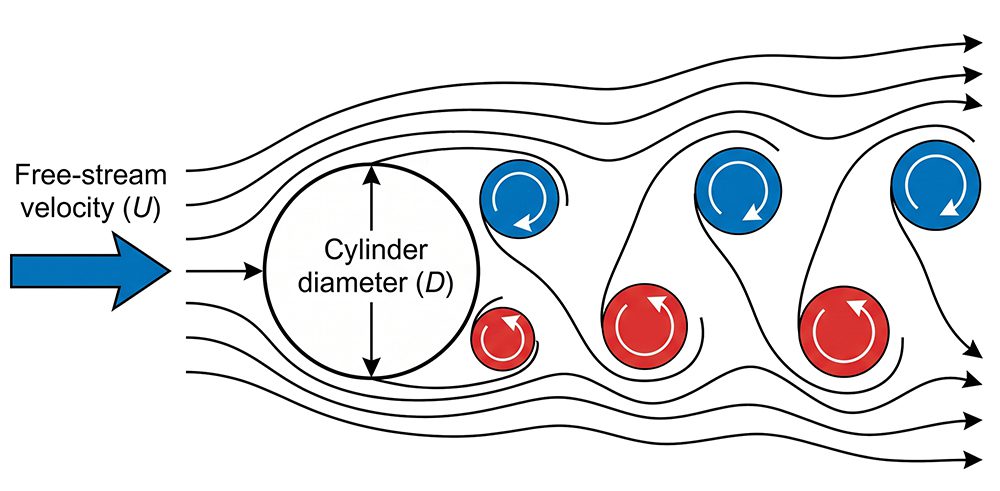
Vortex shedding occurs when wind passes around a railing element and creates alternating air currents behind it. These forces can cause the railing to vibrate and produce an audible tone.
In the original 2024 “singing buildings” case, wind excitation at approximately 80 to 100 Hz aligned with a lightly damped structural resonance at about 80 Hz. This amplified the railing vibration, created strong tonal noise inside the building, and contributed to cracking at railing connections.
| Wind excitation | Regular vortex shedding | Structural amplification | Indoor tonal noise |
Can a Railing Whistle Without Significant Structural Vibration?
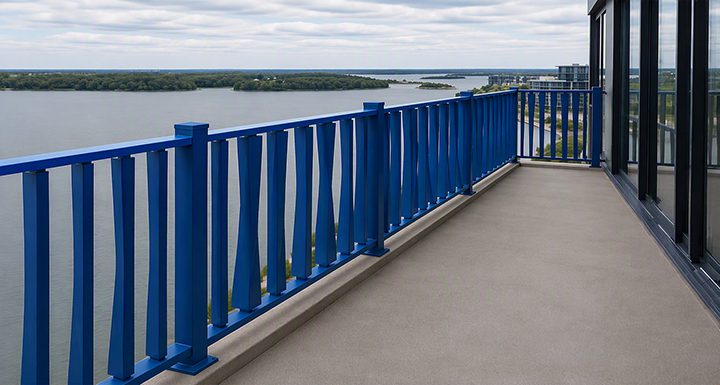
Yes. A more recent case involved a waterfront residential development featuring an irregular railing system. Although lower-frequency tones were present, the dominant tone occurred at a much higher frequency under certain wind speeds and directions. It did not correspond with the railing’s structural natural frequencies, and structure-borne noise was minimal.
The key was the spacing between the vertical elements, which corresponded to a standing-wave frequency. The likely mechanism was aerodynamic noise amplified within the narrow spaces between adjacent tubular sections.

| Turbulent airflow | Aerodynamic sound | Standing-wave amplification | Dominant airborne whistle |
The contrast was important: the earlier railing tone was amplified by structural vibration, while the newer whistle was primarily an airborne acoustic interaction between closely spaced elements.
How Was the Higher-frequency Railing Whistle Controlled?
HGC evaluated potential treatments through modelling and wind-tunnel testing, beginning with simple foamcore modifications, through metal prototypes, and testing of different parameters. The successful solution disrupted the airflow and reduced the interaction between neighboring elements.

This showed that both the treatment itself and where it was applied mattered. The repeating interaction between neighboring elements had to be interrupted throughout the railing design.
What Is Flow-Induced Acoustic Feedback?
Flow-induced feedback in perforated plates is another mechanism capable of producing distinct tones. In simplified terms, vortices form at the upstream edge of a perforation, move downstream, and interact with the downstream edge, generating sound. The resulting sound radiates back upstream and influences subsequent vortex formation, creating a self-reinforcing loop.
In the case study tones appeared and disappeared under windy conditions. The interaction was difficult to predict and capture through field assessment because it occurred only occasionally at any specific location, even though it occurred frequently somewhere on the railing system.
The solution, developed in conjunction with wind-tunnel testing, combined several remedies. Aluminum plates containing sandwiched damping material were added to increase mass, introduce damping, and disrupt the airflow. The treatment addressed the interacting aerodynamic and structural behavior rather than relying on a single type of modification.
Why Railing Noise Mitigation Cannot Be One-Size-Fits-All
Successful mitigation measures are defined by the specifics of a given situation, parameters including the railing system type, physical size of components or perforations, mass, stiffness, damping, and size, as well as the anticipated range of wind speeds.
This is a critical distinction for retrofit programs. A concept that succeeds on one building’s railing system should not automatically be copied onto another because the railings look similar or the reported sounds seem alike. The mechanism, geometry, dynamic behavior, and treatment configuration all need to be considered.

How Are Wind-Induced Railing Noise Problems Best Investigated?
A combined assessment approach involving three complementary methods is recommended:
- In-situ monitoring to document when and where the sound occurs under actual wind conditions, and to verify tonal frequencies and structural responses
- Analytical or numerical modelling to identify and verify the aerodynamic, acoustical, and structural mechanisms contributing to the issue, and to identify potential mitigation solutions
- Wind-tunnel testing to reproduce the problem, and to evaluation mitigation under a range of controlled wind speeds and angles of attack
Each method addresses a different challenge. Field monitoring captures the real problem but depends on capturing the right wind conditions. Modelling helps investigate possible physical explanations but can be difficult for complex airflow and geometry. Wind-tunnel testing allows the relevant variables and proposed design changes to be assessed under controlled, repeatable conditions.
Wind-tunnel testing is often key to verifying mitigation performance before a treatment is implemented widely. This is especially important where a proposed retrofit will be repeated across many balconies or alter an architecturally prominent part of the building.
When Should Aeroacoustic Railing Risk Be Addressed?
Wind-induced noise risks are easier to manage while railing geometry, spacing, materials, and attachment details are still being designed.
Retrofit solutions can be costly, and can impact the visual appeal of a building. Once a building is occupied, mitigation must address not only acoustical performance but also constructability, durability, access, safety, and architectural appearance. Gaining acceptance for post-construction changes that affect a building’s visual design is typically challenging.
Early aeroacoustic review cannot guarantee that every possible wind-induced interaction will be identified. It can, however, flag repeating geometries and airflow paths that warrant further assessment, support focused mock-up testing, and allow potential modifications to be evaluated before the railing design is repeated across the façade.