


Regina, Saskatchewan’s Updated Noise Attenuation Policy

Regina’s Updated Noise Attenuation Policy: What It Means for Capital Works, Land-Use Development, and Urban Planning in Saskatchewan
The City of Regina’s adoption of a new Noise Attenuation Policy in June 2025 is an important development for anyone working in transportation engineering, municipal planning, subdivision design, and acoustical consulting in Saskatchewan. The policy formalizes how traffic noise must be assessed and mitigated in both public infrastructure projects and private development applications. Its influence extends across road design, subdivision approvals, and architectural planning throughout the city.
Regina has long relied on the Noise Abatement Bylaw No. 6980 to regulate disruptive activities. That bylaw focuses on behavioural noise such as loud music or unnecessary vehicle noise. The new Noise Attenuation Policy takes a different approach by establishing a technical framework specifically for traffic-related noise and how it should be evaluated around noise-sensitive land uses such as homes, schools, and outdoor amenity spaces. According to the published policy, projects must be designed so that noise at designated outdoor assessment points does not exceed 60 dBA Leq (16-hour daytime) in future conditions.
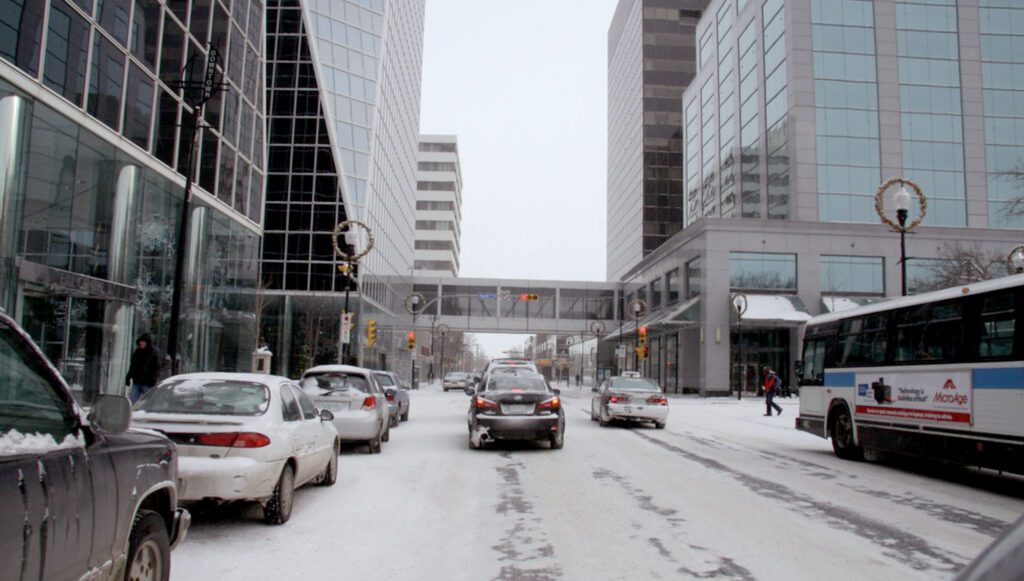
Traffic Noise Requirements for Regina Capital Works and Roadway Infrastructure Projects
For capital construction and roadway modification projects in Regina, the updated policy creates clear triggers for when a noise study is required. If projected future noise will rise at least 5 decibels above the “no-build” scenario and is expected to exceed the 60 dBA design limit, the city requires a detailed noise assessment completed by a qualified professional engineer. The study must use accepted modeling practices and must rely on projected traffic volumes associated with ultimate build out, not interim or early-stage conditions.
This approach ties noise mitigation to long-term roadway conditions rather than short-term assumptions. It also means that roadway geometry, traffic forecasts, and adjacent land-use planning must be coordinated early. Where mitigation is necessary, the policy requires noise barriers to deliver at least a 5 dB reduction for the first row of affected outdoor areas, while aiming to bring overall levels as close as possible to the 60 dBA threshold. Any barrier must also pass administrative, technical, and economic tests.

Noise Standards for New Residential, Institutional, and Mixed-Use Development in Regina
The new policy also applies to private development when new noise-sensitive uses are introduced near major roadways. Even when a developer is not required to submit a full noise study due to screening distances, the development must still demonstrate compliance with the 60 dBA design limit at outdoor assessment locations. This requirement will influence how architects and planners design site layouts, orient buildings, and position outdoor spaces such as patios, playgrounds, or shared courtyards.
Barrier structures, if required, must be designed to meet the city’s specifications and must demonstrate effective performance at the time of handover. Developers will need to account for this engineering and design work early in the lifecycle of projects so that noise mitigation can be considered alongside servicing, transportation access, and other municipal requirements.
Comparing Regina Noise Study Requirements to Saskatoon’s
Understanding how Regina’s approach fits within the broader provincial and federal picture helps clarify where the city is moving.
In Saskatoon, the Traffic Noise Sound Attenuation (TNSA) program has been in place for many years. Under this program, noise attenuation measures are typically required for new residential developments that back onto high-speed or high-volume corridors. Saskatoon’s criteria have historically used a threshold of 65 dBA Ldn (day-night average) for identifying where mitigation is appropriate in areas without existing barriers.
Compared with Saskatoon, Regina’s updated 60 dBA daytime threshold represents a more conservative limit for new development and road design. Regina also places a stronger emphasis on forecasting noise under full build-out conditions, which may result in earlier identification of areas where attenuation will be needed. Saskatoon’s emphasis has often been on developer-built attenuation during subdivision construction, while Regina’s updated policy more tightly integrates noise considerations with municipal capital works planning and long-term roadway expansion.
Comparing Ontario MTO and Regina Noise Mitigation Criteria for Road Projects
Ontario’s Environmental Guide for Noise, prepared by the Ministry of Transportation (MTO), provides a useful benchmark for Regina’s updated approach. Both policies require sound level predictions for road widening or capital works projects under the full build-out scenario in amenity areas associated with residences. Regina’s policy mandates mitigation when the predicted overall sound level exceeds 60 dBA and the post-project level is at least 5 dB higher than the pre-project level. In contrast, the MTO requires mitigation when the post-project sound level exceeds 65 dBA or when the sound level increases by at least 5 dB compared to the “do-nothing” scenario.
The Value of Acoustical Consulting in Navigating Saskatchewan Noise Regulations
The policy also supports a broader shift toward proactive community planning in Saskatchewan. As cities grow and road networks expand, incorporating acoustical considerations into capital planning helps reduce future conflicts and minimizes the need for expensive retrofits. The result is a more resilient and thoughtful approach to urban growth, one that balances transportation needs with livability and long-term neighbourhood quality.
Acoustical consultants with expertise and experience, such as HGC Noise Vibration Acoustics, play a critical role in this process. They help municipalities, developers, and planners better understand and navigate the complexities of noise regulations, which often vary across jurisdictions and can be challenging to interpret. By providing clear guidance, predictive modeling, and practical solutions, acoustical consultants ensure compliance while supporting design decisions that enhance community well-being. Their involvement early in planning stages reduces risk, avoids costly delays, and fosters sustainable growth aligned with regulatory requirements.

