


Windrise Wind Energy Project, Alberta

Location: Fort MacLeod area, Alberta (Willow Creek region)
Owner/Operator: Transalta
How HGC conducted a Post‑construction comprehensive sound level survey for a Wind Power Project in Alberta
The Windrise Wind Energy Project is a utility‑scale onshore wind facility in southern Alberta, located in the Fort MacLeod area and commonly described as part of the Willow Creek region’s expanding renewable generation footprint. Windrise is a development with 43 turbines and roughly 207 MW of installed capacity supplying power to Alberta’s grid. In a landscape shaped by open agricultural land, strong prevailing winds, and dispersed rural residences, projects of this scale rely on careful post‑construction verification to confirm that operating sound levels at nearby homes align with Alberta’s noise requirements once turbines are fully in service.
AUC Rule 012 – Noise Control (“Rule 012”)
Because this work is performed in Alberta under the jurisdiction of the Alberta Utilities Commission, the post‑construction compliance assessment is carried out with direct reference to AUC Rule 012 – Noise Control (“Rule 012”), which sets out the province’s framework for permissible sound levels and how noise compliance is evaluated for regulated facilities.
Post‑construction noise verification for wind farms in rural Alberta is rarely a simple exercise in collecting readings and moving on. Sound levels at rural dwellings can shift with wind‑driven vegetation, weather, wildlife activity, and intermittent local sources such as farm operations and traffic on nearby roads. In this context, a defensible assessment must do more than record sound—it must distinguish turbine sound from changing background conditions and ensure that the dataset represents meaningful operating and propagation conditions, consistent with the intent of Alberta’s regulatory process.
Acoustical Design Challenge for a Utility‑Scale Wind Energy Facility
HGC Noise Vibration Acoustics was retained to complete this post‑construction comprehensive sound level survey at five noise‑sensitive receptor locations near the Windrise Wind Energy Project. The field program was conducted over a multi‑month window to capture a broad range of operating and meteorological conditions typical of southern Alberta’s wind regime.
A key part of the approach was practical receptor‑based siting. Monitoring locations were planned near each residence, typically positioned in the direction of the nearest influential turbines and set back from local interferences such as trees, barns, hedges, and roads as far as practicable. Final monitoring points were confirmed in the field at deployment, recognizing that on‑the‑ground conditions ultimately determine whether a site is suitable for long‑duration measurement and whether it will remain secure and representative over time.
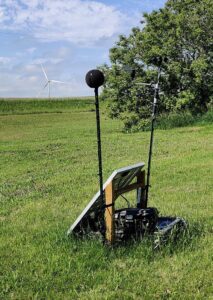 Unattended Remote Noise Monitoring Deployed
To support extended unattended monitoring, HGC deployed solar‑powered monitoring stations designed for continuous operation and remote oversight. Remote connectivity allowed HGC staff to track status and identify potential issues early, while routine site checks focused on ensuring equipment remained undisturbed and functional—an important practical consideration for long‑term rural monitoring programs
Environmental Noise and Low‑Frequency Sound Considerations
Rural sound environments often contain natural low‑frequency energy from wind and other ambient sources, which can complicate interpretation if it is not evaluated carefully. For Windrise, HGC’s review included a targeted assessment of low‑frequency tonal characteristics at locations where indicators warranted additional scrutiny. The analysis concluded that tonal components of concern were not present, meaning no tonal penalty was applied in the compliance evaluation.
This measured, evidence‑based “verify rather than assume” approach is important for credibility—particularly for wind projects where questions about low‑frequency sound may arise. It demonstrates that potential low‑frequency characteristics were examined objectively and that the compliance outcome reflects turbine operation under representative conditions.
Compliance Verification and Operational Confidence in Southern Alberta
The objective of the post‑construction work was to confirm that operational sound levels at the specified receptor locations aligned with Alberta’s regulatory expectations and the project’s approval requirements. The Windrise monitoring and analysis program concluded that the wind project met the applicable sound level limits at the assessed receptor locations, based on the comprehensive survey methods and screening approach applied across the monitoring period.
Acoustical Services Provided by HGC Noise Vibration Acoustics
-
Post‑construction comprehensive sound level survey (CSL) at designated receptor locations
-
Long‑duration unattended environmental noise monitoring with remote system oversight
-
Meteorological monitoring to support interpretation of sound propagation conditions
-
Operational data coordination (SCADA parameters) to confirm representative turbine operation during monitoring
-
Low‑frequency tonal screening and documentation to support compliance conclusions
-
Regulatory compliance evaluation and reporting aligned with AUC Rule 012 – Noise Control (“Rule 012”)


