


EMS Southgate Truss Manufacturing Facility

Location: Southgate, Ontario
Owner/Operator: EMS Construction Inc.
Planning Consultants: Cornabus Planning
How HGC Conducted a Noise Feasibility Study for a Proposed Manufacturing Facility in an Ontario Class 3 Rural Acoustical Environment
HGC Noise Vibration Acoustics was retained to prepare a Noise Feasibility Study in support of a Zoning By-law Amendment application. The proposed project involved the development of a truss manufacturing facility in the Township of Southgate, Ontario. The facility will be located in a rural setting with nearby agricultural lands and existing residences to the west and south, making land-use compatibility and environmental noise an important consideration for the municipal approvals process.
Site Description and Context
The site plan identified a manufacturing workshop including sophisticated CNC lumber machining and layout tables, a utility building, storage yard and loading area for the assembly, handling and movement of prefabricated truss components.
A unique aspect of this facility is its role within the vertically integrated supply and distribution chain of the area Mennonite community. The process begins with harvesting and milling lumber from local woodlots, allowing the use of custom-sized timber—including lengths far beyond what is typically available at a retail lumber supplier. It continues with the largely automated manufacture of roof trusses and the distribution of building materials throughout both the Mennonite and broader communities. It gives new meaning to the term “barn raising.”
Introducing a new industrial or manufacturing use into a rural environment requires careful consideration of how operational sound may be experienced at surrounding noise-sensitive receptors. In this case, the proposed truss manufacturing facility was assessed in relation to nearby residences, with particular attention to the rural acoustic character of the area. The surrounding environment was categorized by the Ontario Ministry of the Environment, Conservation and Parks (MECP), as a Class 3 rural acoustical environment where ambient sound is generally dominated by natural sounds rather than consistent road traffic or urban activity.
MOECP Guideline NPC-300, Environmental Noise Guideline
HGC assessed the facility under MECP’s NPC-300, Environmental Noise Guideline – Stationary and Transportation Sources – Approval and Planning. NPC-300 is Ontario’s key environmental noise guideline for assessing stationary sources such as industrial and commercial operations, and for supporting land-use planning decisions where noise-sensitive uses and noise-generating uses may affect one another.
The Township of Southgate’s zoning framework also formed part of the planning context. The Township describes its zoning by-law as the legal tool used to manage land use, building placement, permitted uses, parking requirements and the separation of uses to help reduce land-use conflicts. Because the noise study was prepared in support of a Zoning By-law Amendment, HGC’s role was to help determine whether the proposed facility could be accommodated from an environmental noise perspective.
HGC’s Acoustical Assessment Approach for Ontario Class 3 Rural Environments
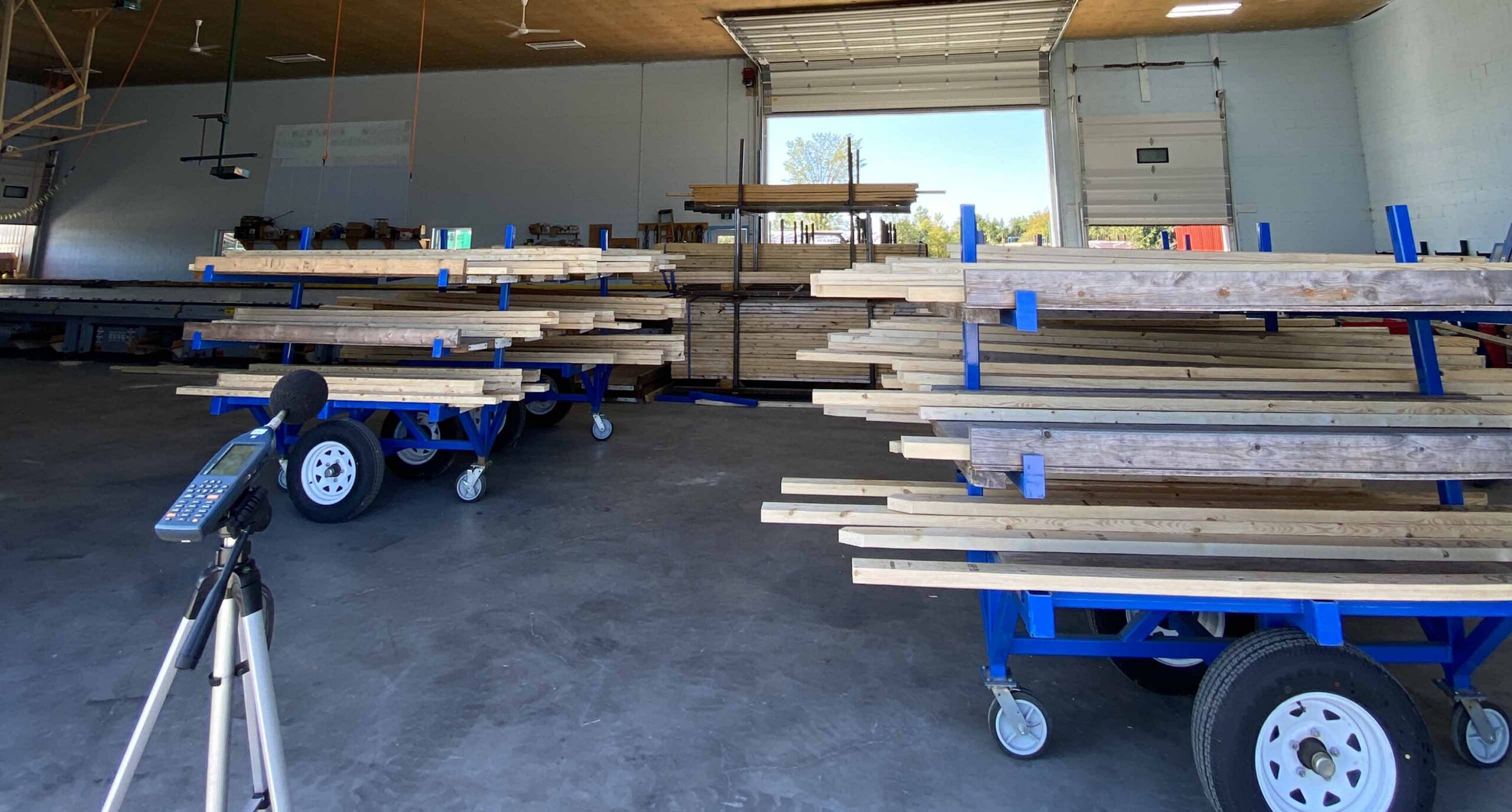
HGC’s assessment began with a review of the proposed site layout and operating concept, supported by discussions with EMS Construction, a visit to the project site, and observations at an existing truss manufacturing facility to better understand typical activities and sound sources. This allowed HGC to establish a realistic operating scenario for the proposed Southgate facility and identify the sound sources most relevant to nearby residences.
The principal sources considered included activity within the truss manufacturing workshop, exhaust fans, utility-room ventilation, forklift movement in the storage yard, circular saw use, truck arrivals and departures, truck idling and loading-area activity. HGC also considered the orientation of the proposed building, including the location of material access doors away from nearby residences, the anticipated construction of the workshop, and the use of passive ventilation and exhaust equipment.
To predict sound propagation from the proposed facility to neighbouring receptors, HGC used acoustic modelling software. The model incorporated site geometry, building shielding, ground conditions, the location of surrounding receptors and the sound characteristics of the anticipated operations.
Stationary Noise and Impulsive Sound Considerations
The assessment distinguished between steady operational noise and impulsive sound associated with activities such as hammering, nail-gun use or other short-duration manufacturing sounds. Under NPC-300, both types of sound are relevant when assessing a stationary source in relation to nearby sensitive points of reception, including the façade of a residence and associated usable outdoor amenity areas.
HGC modelled a representative busiest daytime operating condition for the facility, reflecting the combined operation of workshop activity, ventilation equipment, yard activity, cutting operations and truck movements. The assessment focused on daytime use because the proposed facility was understood to operate during daytime hours only, with no evening or nighttime activity included in the operating scenario.
The results indicated that predicted steady-source and impulsive-source sound levels at the representative nearby residences were expected to satisfy the applicable MECP guideline limits. The study concluded that the proposed truss manufacturing facility is feasible from a noise perspective, based on the operating assumptions and proposed site plan reviewed.
Acoustical Services Provided by HGC Noise Vibration Acoustics
- Noise Feasibility Study in support of Zoning By-law Amendment approvals
- Review of proposed site layout, operating assumptions and nearby sensitive receptors
- Site visit and review of comparable truss manufacturing operations
- Assessment of steady stationary noise sources and impulsive manufacturing sound
- Predictive environmental noise modelling using Cadna/A and ISO 9613-2 methods
- Evaluation of compliance with MECP Guideline NPC-300
- Review of operational feasibility from an environmental noise perspective
- Recommendations regarding the need for mitigation and conditions requiring reassessment
