


Lajord Renewable Wind & Solar Energy Centre Saskatchewan

Location: Lajord, Saskatchewan
Owner/Operator: Invenergy
Consulting Engineers: KGS Group
How HGC conducted a Noise Impact Assessment for a utility-scale renewable wind and solar energy project in Saskatchewan
The Lajord Renewable Energy Centre brings together wind and solar power generation within a single, coordinated project footprint in the Rural Municipality of Lajord located southeast of Regina. The wind energy portion of the project has been planned for a capacity of up to 500 MW. The development has been advanced alongside a formal environmental review process and community engagement, reflecting the scale and visibility that utility‑scale renewable energy projects can carry in rural settings where residences, farmsteads, and small communities share the surrounding landscape.
Acoustical Challenges of Rural Renewable Energy Developments
Renewable energy developments introduce a distinct acoustical challenge: the project’s sound emissions must be evaluated against the quiet baseline conditions typical of rural agricultural land uses, while also accounting for the operational characteristics of wind turbines and ancillary electrical equipment. In Saskatchewan, the challenge is compounded by the absence of a dedicated provincial framework that defines acceptable operational noise limits for renewable energy facilities, requiring project teams to adopt a clear and defensible standard for prediction and compliance demonstration.
For Lajord, the assessment context also included existing industrial and energy-related infrastructure within and near the broader project area, such as substations and compressor/pump facilities, which can contribute to cumulative off‑site sound levels and influence how receptors experience the total acoustic environment.
HGC’s acoustical assessment approach
HGC Noise Vibration Acoustics was engaged to provide a comprehensive Noise Impact Assessment tailored to the project’s rural receptor environment. Because Saskatchewan does not provide project‑specific renewable energy noise criteria, the work was structured to align with the intent and methodology of Alberta Utilities Commission (AUC) Rule 012 – Noise Control, creating a consistent basis for determining receptor limits and evaluating compliance.
The work began with a careful review of project layout information and surrounding land uses to identify noise‑sensitive receptors and to understand how people occupy and use nearby dwellings—particularly during quieter evening and nighttime conditions when industrial sound is typically most noticeable. HGC’s team also considered the presence and operating characteristics of existing facilities in the area, recognizing that rural soundscapes are often shaped by a combination of steady industrial sources, intermittent activity, and naturally varying wind‑related ambient sound.
 Baseline ambient noise monitoring and attended measurements
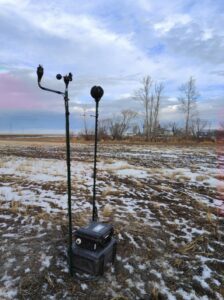
To ground the model in representative site conditions, HGC conducted baseline ambient monitoring at multiple receptor locations during winter conditions and supplemented that work with attended measurements of relevant existing energy infrastructure in the vicinity. This approach helps ensure that predicted results reflect both the project’s expected sound contribution and the broader cumulative context that residents may experience.
Noise and low-frequency considerations for combined wind and solar infrastructure
Sound from wind energy facilities is often characterized by broadband aerodynamic sound that varies with wind speed and atmospheric conditions, while balance‑of‑plant equipment and electrical components can introduce more steady sound. In combined wind‑and‑solar developments, inverter stations and related electrical infrastructure can also contribute to the overall acoustic footprint, particularly where these components are clustered.
A further consideration in rural wind projects, is the community sensitivity to tonal or low‑frequency components—issues that can become prominent in quiet nighttime environments depending on operating conditions and the relationship between A‑weighted and C‑weighted sound levels. As part of the overall assessment methodology aligned with AUC Rule 012, HGC incorporated evaluation steps intended to identify whether elevated low‑frequency noise would be expected at receptors under representative operating scenarios.
Predictive noise modeling and cumulative receptor evaluation
With baseline and attended measurement information in place, HGC developed an outdoor sound propagation model to predict off‑site sound levels at identified noise‑sensitive receptors, consistent with the modeling and evaluation intent used for energy projects under AUC Rule 012. The modeling framework considered the project’s primary operational sources, receptor placement and height conventions typically used for residential evaluation, and cumulative contributions from relevant existing facilities where applicable.
Because large renewable energy sites often evolve through iterations of equipment selection and layout refinement, HGC’s scope also anticipated iterative modeling to support design decision‑making and to confirm that the project configuration remained aligned with applicable receptor criteria as the design progressed. This iterative workflow is especially valuable for rural projects, where relatively small adjustments in turbine placement, equipment clustering, or setbacks can meaningfully influence modeled receptor outcomes.
Acoustical Services Provided by HGC Noise Vibration Acoustics
-
Noise Impact Assessment planning and execution for a utility‑scale wind and solar renewable energy facility
-
Receptor identification support and review of site layout and surrounding land use context
-
Baseline ambient noise monitoring at representative receptor locations
-
Attended noise measurements of relevant existing energy/industrial facilities for cumulative context
-
Predictive sound modeling and iterative assessment support during project refinement
-
Compliance evaluation framework aligned with Alberta’s AUC Rule 012 – Noise Control (applied due to the absence of Saskatchewan‑specific renewable energy noise criteria)

