


Canadian Nuclear Safety Commission

Location: Smiths Falls, Ontario
Owner/Operator: Canadian Nuclear Safety Commission (CNSC)
Noise Exposure Assessments During Safety Readiness Exercises Using Firearms & Explosives
The Canadian Nuclear Safety Commission (CNSC) is Canada’s independent federal regulator responsible for nuclear safety and security. Its mandate includes overseeing nuclear facilities, enforcing compliance with safety standards, and ensuring the protection of workers, the public, and the environment. CNSC conducts rigorous safety readiness exercises to prepare personnel for emergency scenarios involving high-risk conditions, including simulated security threats.
These safety readiness exercises, conducted at indoor and outdoor facilities, simulate high-risk scenarios, including the use of blank ammunition, (using AR-15-style rifles), distraction devices (flashbangs/stun grenades), and improvised explosive devices (IEDs). These exercises are essential for operational preparedness but introduce significant potential impulsive noise hazards for staff acting as observers. Unlike continuous industrial noise, impulsive sounds from firearms and explosives pose unique risks due to their extremely high peak levels and short duration, which can cause immediate auditory damage if not properly controlled.
Canada Occupational Health & Safety Regulations and Impulsive Noise
Canadian occupational health and safety regulations provide general noise exposure limits but lack specific criteria for impulsive noise. This regulatory gap left CNSC without a clear framework for assessing and mitigating risks during these exercises. CNSC engaged HGC Noise Vibration Acoustics with expertise in analyzing firearm and general impulsive noise scenarios to develop a robust acoustic assessment methodology and recommend practical hearing protection strategies to ensure compliance with safety obligations under Part XIX of the Canada Occupational Health and Safety Regulations.
HGC’s Acoustical Assessment Approach for Impulsive Noise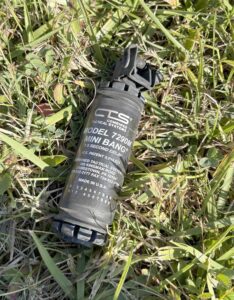
HGC’s team began by reviewing CNSC’s operational requirements and the regulatory context. Recognizing the absence of Canadian standards for impulsive noise, HGC adopted the U.S. Department of Defense MIL-STD-1474E standard, which provides detailed criteria for firearms and explosive devices. This standard introduces two critical metrics, applicable to CNSC’s exercises:
- 140 dBP peak pressure limit to prevent immediate mechanical damage to hearing.
- Noise dose calculation to quantify cumulative exposure across multiple impulsive events.
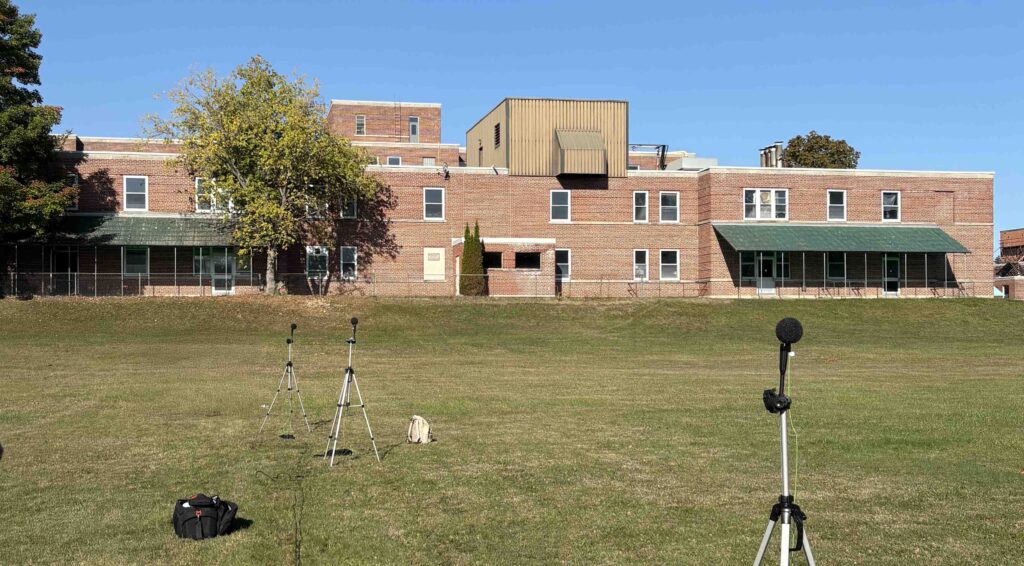
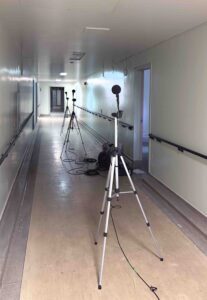
Due to scheduling constraints, actual exercises could not be measured. Instead, HGC conducted controlled testing at CNSC’s Smiths Falls training facility, measuring peak sound levels and energy doses from individual discharges of four device types—blank ammunition, full-strength distraction devices, training distraction devices, and simulated IEDs—at multiple distances indoors and outdoors. These measurements allowed CNSC to model cumulative exposure for any future exercise scenario.
 Acoustical Considerations for Indoor Firearm and Explosive Discharges
Indoor environments presented a particular challenge. While peak sound levels indoors and outdoors were similar, reverberation in narrow hallways significantly increased the acoustic energy duration, resulting in higher cumulative doses. This finding underscores the importance of considering room acoustics when planning exercises. Outdoor environments or larger rooms with absorptive finishes can substantially reduce exposure risk.
Recommended Hearing Protection Solutions Around Firearms or Explosive Devices
HGC recommended a tiered approach to hearing protection:
- Mandatory hearing protection for all exercises involving firearms or explosive devices.
- Double protection (earplugs plus earmuffs) for observers within 30 meters of distraction devices, which produced peak levels exceeding 140 dBP.
- Selection of hearing protectors meeting minimum Noise Reduction Ratings (NRR)
Training on proper fit was emphasized, as field performance varies significantly from laboratory ratings. Earmuffs generally provide more consistent protection than earplugs, while double protection offers an additional safety margin for high-risk scenarios.
Supplementary Workplace Noise Control Strategies Suggested
Beyond hearing protection, HGC advised CNSC on supplementary control measures aligned with Canadian safety regulations, which prioritize engineering and administrative controls over personal protective equipment. Recommendations included:
- Increasing observer distance from discharge points.
- Conducting exercises outdoors where feasible.
- Limiting the number of discharges without compromising training objectives.
- Considering muzzle suppressors for firearms, subject to operational and regulatory constraints.
These strategies, combined with proper hearing protection, enable CNSC to maintain operational realism while safeguarding personnel.
Acoustical Consulting Services Provided by HGC Noise Vibration Acoustics
- Controlled measurement of impulsive noise from firearms and explosive devices.
- Development of a dose-based exposure assessment methodology.
- Evaluation of indoor and outdoor acoustical environments.
- Recommendations for hearing protection selection and fit training.
- Guidance on supplementary engineering and administrative controls.
- Support for compliance with Canadian occupational health and safety regulations

