


CAE & WestJet Flight Simulation Training Facility, Calgary Airport

Location: Calgary, Alberta
Owner/Operator: Calgary Airport Authority (YYC)
Architect: Figurr Architects
How HGC addressed building envelope environmental noise challenges and interior acoustics for an aviation training facility at Calgary’s International Airport
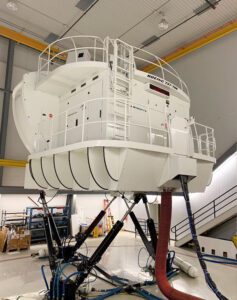
The proposed CAE & WestJet Flight Simulation Training Facility at Calgary International Airport represents a significant investment in aviation training infrastructure, supporting pilot development through advanced simulation technologies, classrooms, and operational training environments. Planned as a multi-storey facility on a strategic airside land parcel, the development forms part of a broader aviation and aerospace training initiative at YYC. Its proximity to active airfield operations—including aircraft de-icing pads and a future engine test cell—placed acoustical performance at the forefront of the design conversation, particularly in ensuring a controlled indoor environment for simulation accuracy, learning effectiveness, and occupant comfort.
HGC Noise Vibration Acoustics was retained to evaluate the potential impact of airside operational noise on the building envelope and resulting interior acoustic conditions. The site context introduced unique challenges: the facility is directly adjacent to an expanding de-icing pad and in close proximity to a future engine test cell, both of which generate intermittent high-intensity noise events associated with aircraft operations
Assessing Noise in a Complex and Active Airport Acoustic Environment
These noise sources differ from typical urban environmental noise in both character and variability. Aircraft de-icing activity produces fluctuating sound levels tied to aircraft type, engine orientation, and operational cycles, while engine testing introduces concentrated, high-energy noise emissions. Together, they create a complex acoustic environment with the potential to significantly influence façade performance and indoor sound levels if not properly addressed at the design stage.
HGC’s role focused on ensuring that the building envelope could effectively mitigate these external noise sources while supporting the highly controlled acoustic requirements of simulation rooms, classrooms, and office spaces.
HGC’s Acoustical Assessment Approach
The assessment began with a comprehensive review of available architectural drawings, site plans, and operational data for both existing and future airside activities. HGC also conducted on-site sound monitoring to observe and capture representative de-icing operations, allowing the team to better understand the acoustic signature of various aircraft and activity patterns.
Building on this fieldwork, HGC developed a detailed computational acoustic model of the site, incorporating de-icing operations and projected noise emissions from the engine test cell facility. This modelling approach enabled the team to simulate how sound propagates across the site and interacts with the proposed building envelope at different façades and elevations.
A critical component of the analysis involved translating exterior noise exposure into expected interior conditions. Using established acoustic performance criteria, the team assessed how various façade assemblies—including concrete walls, glazing systems, spandrel panels, and overhead doors—would influence sound transmission into representative interior spaces.
To guide this process, HGC applied Noise Criterion (NC) curves developed by the American Society of Heating, Refrigerating and Air-Conditioning Engineers (ASHRAE). These criteria are widely used to define acceptable indoor background sound levels for different room types, ensuring environments conducive to speech intelligibility, concentration, and occupant comfort. ASHRAE’s guidance helps establish targets for interior acoustic performance by considering both loudness and frequency content of background sound.
 Training Room Acoustics and Speech Clarity Considerations
The facility’s program includes a diverse range of spaces, each with distinct acoustic requirements. Simulation bays and training environments require controlled background noise conditions to maintain realism and avoid masking critical auditory cues. Classrooms and meeting rooms must support clear verbal communication, while open-plan offices benefit from carefully balanced ambient sound levels that promote productivity without distraction.
HGC’s analysis identified that noise intrusion pathways varied depending on the space type and façade configuration. On lower levels, large overhead doors—necessary for operational functionality—emerged as key points of potential sound transmission. On upper floors, glazing and curtain wall components became the dominant pathways through which exterior noise could affect interior conditions.
The study also acknowledged the interplay between exterior noise and internal building systems. Mechanical systems, particularly HVAC, often establish the baseline background sound level in buildings. In many cases, these systems can mask or even outweigh transient exterior noise contributions, making coordinated acoustical design between façade and building systems essential to achieving the intended acoustic environment.
Recommended Acoustical Solutions
Based on the modelling outcomes and performance targets, HGC developed a series of envelope design strategies tailored to the facility’s operational needs and acoustic objectives. Emphasis was placed on strengthening the weakest elements of the façade, recognizing that overall acoustic performance is governed by the least effective component.
For ground-level training spaces, attention focused on enhancing the acoustic performance of overhead doors and access points, ensuring these elements did not compromise the otherwise robust concrete envelope. For upper floors, improved glazing and spandrel panel assemblies were recommended to reduce sound transmission while maintaining architectural intent and daylighting objectives.
HGC also emphasized the importance of a balanced design approach, where different façade elements are selected and coordinated as part of a unified system. This allows flexibility in achieving performance targets while accommodating architectural and budgetary constraints.
In parallel, the study highlighted the need for further coordination with mechanical system design and interior acoustic treatments. Properly designed ceiling finishes and sound-absorptive treatments play a critical role in managing reverberation and maintaining speech clarity, particularly in larger or double-height simulation spaces.
Acoustical Services Provided by HGC Noise Vibration Acoustics
- Building envelope acoustical assessment for aviation training facility
- Environmental noise monitoring of aircraft de-icing operations
- Computational acoustic modelling of airside noise sources
- Evaluation of façade sound transmission and interior acoustic performance
- Application of NC criteria based on ASHRAE guidelines
- Recommendations for glazing, wall assemblies, and overhead door performance
- Coordination considerations for mechanical systems and interior acoustics
- Preparation of technical report documenting methodology and design guidance

