


Vernon Active Living Centre, British Columbia

Location: Vernon, British Columbia
Owner/Operator: City of Vernon
Architect: Group2 Architecture Interior Design
Construction Management: Clark Builders
Supporting a Landmark Community Recreation and Fitness Centre Through Comprehensive Acoustical Design
The Vernon Active Living Centre (ALC) is one of the most significant community investments in Greater Vernon’s history. Envisioned as a vibrant destination for recreation, fitness, cultural gathering, and year-round programming, the $121-million, 130,000 ft² facility is designed to support residents of all ages and abilities while setting new standards for accessibility, sustainability, and user comfort.
Anchored by a hybrid mass-timber structural expression inspired by Syilx Okanagan cultural values, the net-zero-ready centre will strengthen both the physical and cultural fabric of the region. Now under construction and scheduled to open in fall 2026, the project is being delivered through an Integrated Project Delivery (IPD)—a collaborative approach that brings the owner, architect, contractor, and other core partners together from the project outset to streamline decision-making and enhance overall project outcomes.
Comprehensive Acoustical Design Review of City Recreational and Leisure Complex
HGC Noise Vibration Acoustics was retained to provide a full acoustical design review for the base building and interior fit-out. The proposed recreational and leisure complex incorporates a range of large-volume and high-use program rooms—including aquatic centres, gymnasiums, multi-purpose areas, fitness spaces, administrative offices, and community gathering zones—requiring integrated and highly coordinated acoustical solutions.
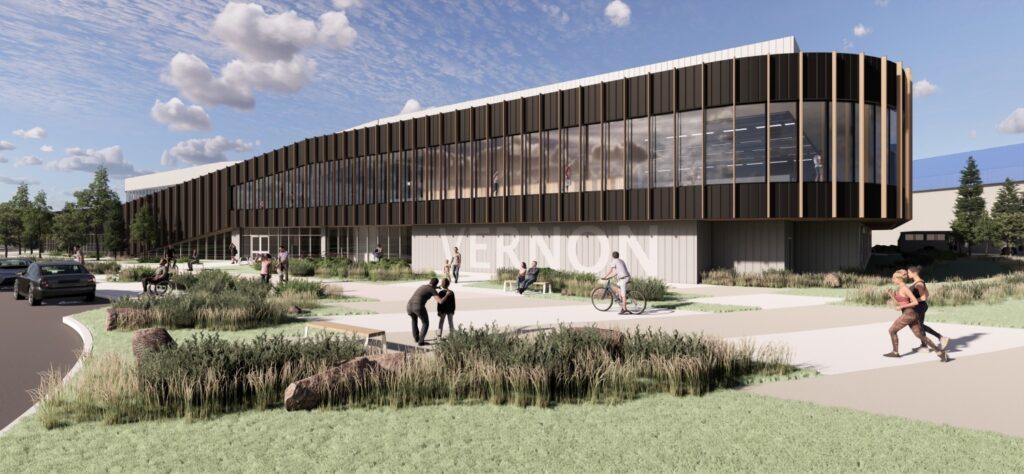
A Multi-use Recreational Facility Designed for High Activity and High Performance
The ALC will feature a premier aquatics complex with a 50-metre competition pool, leisure pool, hot tubs, steam and sauna amenities, and accessible aquatic features. Adjacent to the aquatic centre, the double gymnasium and multi-court layout are designed to support tournaments, camps, and community recreation. A fitness suite with approximately 80 stations, combined with a 150-metre synthetic walking and running track, provides year-round indoor conditioning opportunities. Complementing these spaces are flexible multi-purpose rooms, community gathering areas, and administrative functions.
Indoor Noise Criteria to Support Comfort, Accessibility, and RHFAC Gold Goals
Achieving appropriate indoor background noise levels was central to the project, given the wide range of mechanical, electrical, and aquatic systems required to support the ALC. With no pre-established acoustical criteria from the client, HGC applied industry best-practices based on ASHRAE guidance and HGC’s experience with similar large civic recreation facilities.
As noted, the City of Vernon is targeting Rick Hansen Foundation Accessibility Certification (RHFAC) Gold v4, which emphasizes acoustic comfort, low-reverberation sensory environments, and reduction of intrusive background noise. Although the standard does not prescribe strict numerical indoor targets, HGC’s criteria were selected to align with RHFAC objectives while ensuring speech clarity, acoustic comfort, and effective sound masking in large, open spaces.
Protecting spaces from noise generated by adjacent mechanical rooms—including air handlers, pumps, and transformers—required a coordinated approach to interior sound separation, flanking mitigation, wall assembly selection, and enclosure review.
Outdoor Sound Control in the Absence of Municipal Limits
Because the City of Vernon’s Good Neighbour Bylaw does not provide specific exterior noise limits for offsite receptors, HGC referenced the Regional District of North Okanagan’s Noise Regulation Bylaw No. 2581 (2013). Based on the ALC’s zoning classification, a maximum sound level of 50 dBA / 60 dBC applies at nearby property façades, including the nearby Kal Tire Place Arena to the east and residential receptors south of the site.
HGC completed a full environmental acoustic analysis to assess impacts from exterior mechanical noise sources on neighbouring sensitive uses. Predictive noise modeling was utilized to provide recommendations to the design team for noise control, where required.
Reverberation Control for Speech Intelligibility and User Experience
Many of the ALC’s largest program areas—including the gymnasium and aquatic hall—feature high ceilings, large volumes, and exposed roof deck. These conditions typically result in long reverberation times that compromise speech intelligibility, increase user noise exposure, and limit functional performance of sound systems.
HGC developed reverberation control strategies that combine strategically located acoustic wall and ceiling absorbers, high-performance materials, and NRC-rated treatments where required. Smaller rooms with acoustic tile ceilings were reviewed to ensure minimum NRC 0.8 performance, supporting the RHFAC Gold Certification target and user comfort.
Large-volume spaces were assigned treatment quantities and configurations carefully matched to room geometry, finish selections, and intended occupancy, ensuring that both unassisted and electronic speech remain intelligible while avoiding an overly “dead” acoustic response.
Interior Sound Separation to Support a Multi-use Community Centre Environment
The ALC’s diverse program mix—fitness studios adjacent to offices, large gymnasiums near community meeting spaces, and mechanical rooms located near sensitive areas—required deliberate attention to STC performance, flanking paths, and interface details. Assemblies designed to meet ASTC 55 (STC 60) received particular scrutiny, as these performance levels leave little tolerance for installation deviations.
HGC’s recommendations addressed slab edges, penetrations, junction conditions, and structural connectivity to ensure that required acoustic separation would be achieved in situ. Continuous review with the IPD team supported coordinated detailing to limit acoustic risk during construction.
Summary of the Scope of HGC’s Acoustical Services Provided
-
Establishment of indoor background noise criteria aligned with ASHRAE and RHFAC Gold goals.
-
Environmental noise assessment using Regional District of North Okanagan bylaw limits.
-
Predictive modelling of outdoor mechanical equipment and development of noise mitigation measures.
-
Reverberation analysis and recommendations for acoustic treatment in large-volume and speech-critical spaces.
-
Review of mechanical, electrical, and emergency equipment noise impacts.
-
Interior sound separation design, including STC/ASTC requirements, flanking mitigation, and enclosure detailing.
-
Coordination with the IPD team and support through ongoing construction.


