


Ground-Borne Vibration Testing for Rail Projects in Cold Weather Conditions

Why Does Ground-Borne Vibration Matter for Subway and Rail Projects?
Ground-borne vibration and noise have become increasingly important considerations in infrastructure planning and design as North American cities continue to expand subway, LRT, and regional rail networks through dense urban environments. For hospitals, laboratories, residential/commercial towers, institutional buildings, and other vibration-sensitive receptors near a future underground alignment, vibration is not only a construction-phase concern. Once a transit system is operating, dynamic forces at the wheel–rail interface can travel through soil and rock, reach nearby foundations, and be experienced inside buildings as perceptible vibration or audible low-frequency rumble.
Reliable prediction depends on understanding both the strength of the rail vibration source and the vibration propagates through the actual ground conditions along the alignment. This post is based on a technical paper recently presented at Noise-Con 2026 where HGC’s Nathan Gara showcased the practical and technical challenges of completing Point Source Transfer Mobility testing for a proposed underground subway alignment during a very cold Canadian winter.
How Does Cold Weather Affect Subway Vibration?
Seasonal freezing can change the mechanical properties of near-surface soils, affecting how vibration travels from a tunnel alignment to nearby buildings. Frozen soil generally becomes stiffer than unfrozen soil, and changes in stiffness, damping, wave speed, and impedance can influence the vibration levels measured at grade. This effect is not uniform. In some cases, frozen ground may increase stiffness of the soil and reduce the local response near the source, while at greater distances it may allow vibration to travel further, particularly where surface-wave propagation dominates. Even when train excitation originates below the frost depth, the vibration signal still travels through the near-surface zone before reaching building foundations. Warm-weather measurements alone may therefore not fully represent winter operating conditions.
What is Point Source Transfer Mobility Testing?
 Since a moving train does not exist yet during the design of a new subway, the vibration source is simulated. At each test location, a controlled impact is applied at depths corresponding to the planned tunnel crown and top-of-rail while sensors at grade recorded the vibration response at set distances. The measurements produced a frequency-dependent characterization of the vibration propagation through the local soil and rock profile, capturing the effects of layering, damping, geometric spreading, and impedance changes between materials.
The case study involved PSTM testing at eight locations along the proposed alignment. At each location, a borehole was drilled to two representative source depths corresponding to the tunnel crown and top-of-rail elevations. A force transducer was mounted at the end of the drill string and lowered into the borehole, and controlled impacts were applied using a 130 lb slide hammer, with at least 32 impacts per trial at each depth. At the surface, seven accelerometers were positioned at 5-metre horizontal offsets from 20 metres to 50 metres from the borehole.
Force and response signals were recorded simultaneously using a multi-channel real-time frequency analyzer, allowing the team to calculate PSTM and evaluate the relationship between input force and measured response. HGC’s data was then used by the design team to predict ground-borne noise and vibration impact along the alignment.
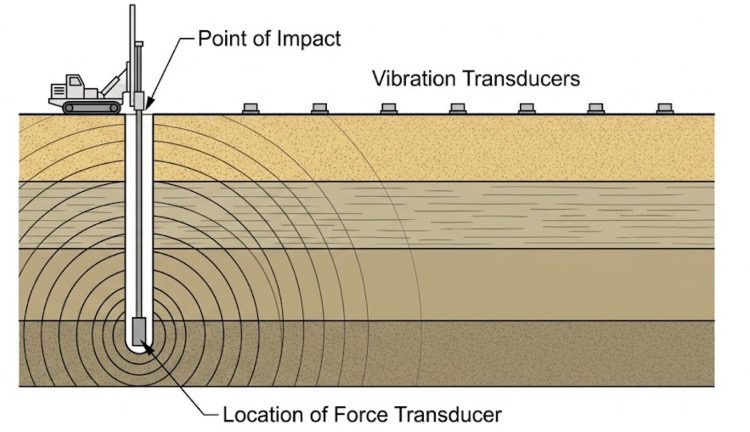
PSTM field test configuration
What Can Affect the Quality of Ground-Borne Vibration Measurements?
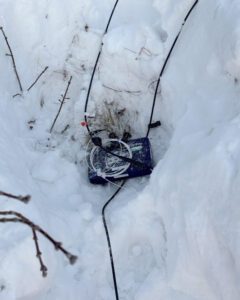
Because the program was carried out during peak winter months, ambient temperatures regularly dropped to -20°C (-4°F). This introduced a series of logistical and technical complexities, particularly around source-to-ground coupling, borehole preparation, and the ruggedization of high-fidelity equipment.
Data quality depends heavily on how consistently the output force is transmitted into the ground. Even in warm weather, groundwater and unstable borehole conditions can alter how force enters the surrounding soil. In freezing conditions, drilling water and mud contributed to viscous, partially frozen sludge within the borehole, complicating deployment and retrieval of the force sensor assembly. The team responded with additional waterproofing and careful handling of the drill string between tests. Even so, the harsh conditions took a toll on the source assembly, a clear lesson that, for cold-weather borehole PSTM, source coupling should be treated as a primary planning task rather than a routine field detail.
Surface coupling required adaptation as well. With the top layer of soil frozen, conventional spike installation became unreliable. Rather than forcing spikes into frost-hardened ground, the team introduced wet soil around each spike and allowed it to freeze, creating a rigid bond that improved repeatability and reduced signal contamination from poor contact.
Commercial data acquisition equipment and sensors are not generally intended for prolonged use at below-freezing temperatures. Cables can become rigid and vulnerable to damage, and common waterproofing materials lose pliability and adhesion. Equipment had to be staged carefully, warmed when possible, and protected from snow, ice, and meltwater.
Personnel exposure was equally critical. Since heavy cold-weather PPE reduced dexterity, fine tasks often required short periods of glove-off work. Also, cold-induced fatigue increased errors and oversights during the field testing. Deliberate pacing, safety planning, and real-time quality checks proved essential to protecting both the crew and the integrity of the dataset.
What Did the Results Show?
Despite the challenges in collecting the data, the results pointed to a clear, usable frequency range. PSTM response was highest between 16 Hz and 200 Hz, while the relationship between force and vibration (coherence) was strongest between 31.5 Hz and 315 Hz. Where those two ranges overlap, roughly 31.5 Hz to 200 Hz, the data were most reliable and well suited to supporting subsequent ground-borne vibration assessment along the alignment.
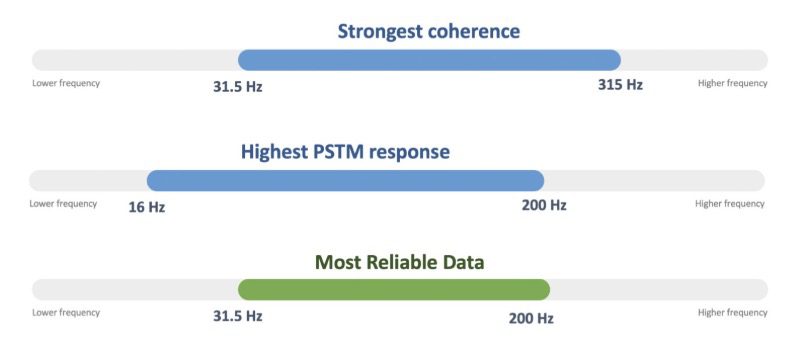
Summary of the most reliable PSTM measurement range
Why Should Acoustical Consultants Be Involved Early in Transit Design?
For subway, LRT, and rail projects, ground-borne vibration assessment should be addressed early, especially where alignments pass near sensitive buildings or future development parcels. PSTM testing provides the site-specific propagation data needed to support defensible vibration predictions, evaluate mitigation, and reduce uncertainty before design decisions become costly to revise. For projects in cold-weather regions, the timing and execution of field measurements demand particular care. Borehole preparation, source and receiver coupling, equipment protection, crew safety, and real-time quality checks all shape the outcome. This case study presented shows that, with disciplined planning and HGC’s expertise, meaningful PSTM data can be obtained even under demanding winter temperature and ground conditions, helping project stakeholders and support partners manage vibration risk across Canadian and U.S. transit corridors.
